Sunday, February 23, 2014

Blog Post #6 PLN's What Are They?

What is a PLN?
PLNs are both people and tools that I, or anyone, can use for the collaboration of information for projects, to help answer questions, research tools, and tools that can help collaborate with other teachers that may blog or tweet information that is of particular interest to you. PLNs are rich in networking tools and collaborative tools and are able to bring, (literally), a whole world of information and make it available at the click of a few buttons. It is overwhelming and exciting all at once to learn about all that is out there and available to anyone willing to access it.
How can PLNs help me as a teacher?
What comes to mind first is PLNs can help me establish a solid network in which to gather information about anything that might concern what we are learning in the classroom as well as the most effective ways to teach it. What teachers once had to learn through years of trial and error is now available to me as a new teacher to be able to benefit from. I feel as if I have just stuck my toe into the very tip of an ocean of information but it is a process that can benefit me from the very start. As a new teacher, I can see using these tools as a way to get insight from teachers who have been in the classroom for long periods of time.
How can I create a PLN?
When I first read this question without having visited the links attached, I was clueless as to who I would incorporate into my PLN and even how to create a PLN. After watching the video by Michael Fawcett , I realize that through browsing Twitter and connecting to other teachers and their blogs, I can find a network of teachers that interest me and that I feel that I can benefit from. It is really just a process of browsing different network sites and also blogs that fellow teachers subscribe to in order to be able to begin the building process of my own PLN.
Who will be the first additions to my PLN?
My first is my EDM310 instructor, Dr. John Strange
The second would be my assigned teacher in for C4T, Andrea Hernandez. Edtechworkshop.com Andrea is a very creative teacher that is not afraid to try new things. I feel that I could learn a lot from her.
These are just the beginning of a long list of PLN’s!
picture of boy surrounded by social websites

C4T #2

Post #1
picture of children sitting on piles of books while smiling and waving
My teacher for this week was Pernille Ripp and the name of his blog post is Reading is Bigger Than Us. For this post, Ripp wrote about reading and how it goes beyond just being able to tell about the book or even beyond writing book reports. Ripp believes that reading a book and then being able to discuss it help to develop thinking and conversation skills that students carry through into their adult years. Ripp states that "we ask questions about books because we must learn to ask questions of others. We must learn to adapt to any conversation thrust upon as adults. To engage and be engaging whenever needed". It is basically connecting with the book and developing thoughts to be able to analyze the work.
I commented that I liked her thoughts about how reading helps us to develop thoughts that go beyond the surface and help us to develop thinking skills. Reading has always given an advantage to students and now there seems to be another good reason to read!

Post #2
This teacher's post was titled "The Kid Who Walked Through My Door Last Night", by Pernille Ripp.
picture of two children embracing and an inscription that says, to make a difference in someones life you don't have to be brilliant, rich, beautiful or perfect. You just have to care enough to be there
This post was a touching story of a middle school child that came back to visit a teacher that they once had before and to ask for help with math. It doesn't take long for the teacher to realize that what this child is looking for is not help with math, but reassurance that everything is going to be okay. They aren't doing the best in their class, they are either tired or laughing out loud too much and at inappropriate times and making their teachers frustrated with them. This child remembers the kindness that their former teacher has shown and the feeling a acceptance that they always felt in that teachers class and this is why they have reached out to this teacher above any other.
I commented that to read a story like this is a reminder of why I have chosen this profession above any other. Teaching is about educating the next generations but it is also about giving the children a place to feel safe and accepted. It is a reminder that in many ways we will be more than educators but also role models and friends. I loved this blog post and it is one that I will visit and read again from time to time as a reminder of why I have chosen teaching as my profession.

Project #8 Book Trailer

Sunday, February 16, 2014

My Sentence Videos

My Sentence Is...

My Passion Is...


Blog Post Assignment #5

For this blog assignment, we watched a series of video interviews that Dr. Strange facilitated where he interviewed Anthony Capps. Anthony Capps is a third grade teacher at Gulf Shores Elementary School and uses PBL in his classroom. The first conversation was about "Project Based Learning" or PBL. Anthony believes that PBL is a means in which to learn and also a means in which to show what you have learned. PBL is very much driven by content. Anthony creates a project that is directed at having the students learn the content that Anthony wants them to learn. Dr. Strange adds that PBL is not about being a consumer when it comes to learning but to be a participant and eventually a producer. With PBL, the students are at times even involved in the grading process.
Of course, like most of anything else, this is not a perfect system. Things do not always go well and it is at these times that Anthony uses these imperfections to challenge himself and his students to find real life solutions to these every day challenges. Even these seeming imperfections bring occasion to learn and be creative. Anthony encourages future teachers not limit our students but to allow them to explore within the boundaries of the assigned project and goes on to say that with this type of approach you will often times get more than you expect from the assignment.

The students have responded positively to this learning style but they do find the collaborative part a bit of a challenge. When using PBL, the students are allowed more freedom in their approach to learning the content and this, as you would expect, generates more excitement. PBL has not only earned high marks with the students but from the administrators and principal as well.

Another topic of discussion that was of particular interest to me was about icurio. As a mother and a future educator, I have been somewhat concerned about the safety of the web pages or video content that are often used when applying PBL. These concerns were put at ease when I learned of icurio. So, what is icurio? Icurio is a safe search engine that has web sites that have been carefully pooled for educational purposes. The searches include text, audio and video.

Dr. Strange and Anthony agree that to be a good teacher, is to be a good learner and PBL encourages the learning process which is essentially a lifelong process. A good teacher must also be flexible and prepared for unplanned situations. Take the time for reflection and self-evaluation because this will only make you a better educator.

These conversations were filled with information for teachers that is rich with day to day experience. What a better way to test PBL than in the classroom?
Interview with Anthony Capps part I
Interview with Anthony Capps part II
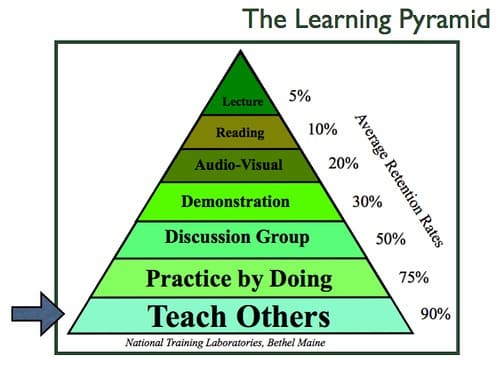
The learning pyramid

Sunday, February 9, 2014

C4T #1


picture of Andrea HernandezThis is Andrea Henandez

It does not take long when you read Andrea Hernandez's blog, the edtechworkshop, to see that she is full of fresh ideas and is a bit fearless when it comes to trying new things. On this particular post, Andrea shares about a "parent night" of sorts where the students were able to share about their 1:1 ipads and the learning apps with their parents, (or guardians). The students were placed in groups of 3 or 4 and each were assigned a station where the parents would go to learn about the particular app that the kids at that group were demonstrating. This allowed for the parents to see first hand how the apps were used and also generated excited among the students for the apps they were demonstrating. I commented that this was a creative idea. I liked that the kids were facilitating the demonstrations and the parents were given opportunity to witness first hand the use of the ipads and learning apps. Yay for Andrea and the other faculty for thinking outside of the box. This one was a definite home run!

The second post that Andrea Hernandez wrote was entitled "Authentic Literacy". This post is about the importance of reading but also it proposes a new strategy in getting children to read. To make the point of "out with the old and in with the new", Andrea uses a soup analogy. She compares canned soup with hand crafted soup saying "processed, canned food was all the rage and seemed like the answer to all the problems of feeding the people. However, it didn't take long to figure out that an authentic, hand-crafted soup was not only more delicious but was healthier and generally the better all-around option". Andrea is a strong proponent of doing what it takes to make learning its most effective, even when it means changing the way we teach things.
I commented that I loved Andrea's analogy to soup and I love her willingness to try new things in order to keep learning fresh and relevant for her students.

Blog Post Assignment #4

"What do we need to know about asking questions to be an effective teacher"?
In Ben Johnson's blog, Mr. Johnson challenges us the rethink why and how we, as teachers, are asking questions. In "The Right way to ask questions in the classroom" he goes on to make the point that when we throw a general question to a general audience such as, "does everyone understand", we are missing the real point in asking the question which would be to make sure that every student understands the concepts being taught. The point is made that some of the students that may have the most questions will be the most quite when the opportunity to answer questions occurs.
So, how do we ask the right questions in order to get "the most bang for the buck"? One approach Mr Johnson suggest is to ask a question, wait three seconds and then call on a child at random. With this approach, during the three second period, the student would then be thinking about the answer in anticipation of their name being called. "Asking Questions to Improve Learning" encourages the teacher to ask direct, clear and specific questions and "use a sequence of questions to build depth and complexity". The point of all of this is the same, making the most of your questions. Use this as a time to cause your students to analyze what is being taught and use their critical thinking skills in order to make the connection between the question being asked and the answer.
students raising their hands

Project # 3 Presentation

Sunday, February 2, 2014

Blog Post #3

For this weeks blog assignment, we watched videos describing what it means to Peer Edit. We learned that editing is a combination of complementing, making suggestions and offering corrections where they may be needed. Also, it is very important that you stay positive throughout the process of editing your peers' blogs. Remember, someone has spent their time and thought in creating their blog and it is important that we respect that and use this as a time to help make their blog better, not rip them and their blog apart, (that could do more harm than good).
Some things to consider when making our suggestions to the writer are, "word choice, using details, organization- can you understand what the author is trying to say? Sentences- Are the sentences too long or too short? Topic- Does the author stick to the topic...?" (Tutorial Peer Editing). Also, it is important to check for mistakes in the work such as spelling, grammar, punctuation. All of these things are important in making sure that the work has an impact that is positive and sends the message that was intended. It is easy for a reader to become sidetracked with bad grammar or maybe to be confused with what the author is trying to say if the writing is not clear. When these steps are done correctly, peer editing can be a useful and positive experience.
What is Peer Editing?
Peer Edit with Perfection
Writing Peer Review Top 10 Mistakes
Picture of three steps to peer editing

Sunday, January 26, 2014

Blog Post Assignment #2

Professor Dancealot
By: Kari Johnson Mr. Dancealot
The central message of Professor Dancealot is that some subjects require physical involvement and lots of hands on practice. The teacher in this video presses this point by trying to teach dancing by lecturing the students with absolutely no opportunity for the student to physically get involved and practice the methods they are being taught. In the end, the students are totally lost and have learned almost nothing in the time they have spent in their class. This subject, (dancing), was one that required physical involvement from the students, yet they, (the students) were given no opportunity for this. I do agree with the conclusion of the message in the video that there are certain subjects that require not only lectures, but student involvement and interaction with methods. It is important that teachers give opportunities for their students to actually practice the skills being taught.
couple dancing


Title: What Does it Mean to Teach in the 21st Century
By: Kevin Roberts Teaching in the 21st Century

1. Introduction: In this video the argument is made that although some may believe that teaching is becoming more and more obsolete because of the huge amount of information now accessible, “whatever, whenever, wherever”, to anyone via the internet, teaching is in fact every bit as important as ever. The role as “teacher”, however, is changing.
A. Web information is limitless to even the greenest of internet users. Facebook, Twitter, Blogger; these are just a few of the most basic tools available for users. Learning to navigate these tools is essential to the success of the student.
B. “Teachers are no longer the main source of knowledge, we are the filter”. The point is made that a student may be able to use google to get the answers they need but “has anyone shown them how-to”? This is a skill that is taught by teachers, not necessarily acquired through repeated, random use.
2. With using something as powerful as the web, there is an equally large amount of responsibility that goes along with it.
A. “Validate information? synthesize information? Leverage information? Communicate information? Collaborate information? Problem solve with information?” How do we do these things and who will make sure that we are taught the proper methods for each of these if not through a teacher?
B. Plagiarism and the like—How do we cite our internet sources and information? These are answers that we look to a teacher to find. “Where do we expect them to learn about pirating, plagiarism, slander, copyright”.
3. Although the information is limitless, we still need a “guide” to help us determine what information is relevant and how reliable the source or sources is.
1. What is a relevant source? This is an important question and one that should not be overlooked. In our age of information overload, it is especially important that we know the correct way to obtain this information so that our information is up-to-date and accurate.
A. Who is a relevant author? This is an important question that cannot be overlooked. This also required a teacher’s guidance.
B. It is equally important that teacher stay relevant by staying up-to-date with information and technology in the 21st century.
Conclusion:
A. The point in this video is well made. We are of a different age. One that might lead us to believe that teachers play less of a role in the learning process of the students based on the crazy amount of information available to us. However, Kevin Roberts goes on to make a strong point that it is the many changes that constitute even more of a need to have the guidance of a teacher.
B. There is also a message to teachers in this video and that we need to stay relevant to the modern student by staying in touch with progress and taking the risk when called for to dive into new technology. “ So what does this mean for the classroom? It means we need to rethink the tools we use and the types of problems we ask our students to solve”. “How could you talk about gathering reliable sources using google, delicious, wikipedia, blogs, podcast?” This is just one example given in the video as to ways teacher need to be rethinking what is being taught in the classroom and how it is being taught.


Title: The Networked Student
Author: Wendy Drexler The Networked Student"
The main argument of this video is that with the growth of technology and the accessibility of unlimited information to High school students, the role of textbooks, and of a traditional full-time teacher in the classroom is almost obsolete. The role of the teacher is now, "learning architect, modeler, learning concierge, connected learning incubator, network Sherpa, synthesizer, change agent”.
This video brings in some good thoughts. The 21st century high school has an impressive data base to offer their students and this together with the initiative of the student make for an impressive learning environment. Learning is done on an individual basis and with every technological tool available to them. It is through these seemingly endless technologies that the student is able to build portfolios and databases to ensure only the best of sources and information filter in. In the beginning of the video the role of the teacher in understated. At the end of the video, a very clear point is made that the teacher is not only useful, but needed.
I was not too impressed with the learning style presented here. My experience as a mother and in life in general, has shown me that some, but certainly not all students possess the drive that would be required for this type of environment. Is it an ideal environment in theory? Yes. Is it realistic and applicable to the real world, I think not. Ideally, this type of school would be amazing. The information and connections that would be available to the students would seem limitless. Who wouldn’t be impressed by this? I do think to bring this type of learning environment to the real world would reveal quite a few warts that would surprise even the most optimist if thinkers.

Harness Your Students’ Digital Smarts
By: Vicki Davis Harness Your Students' Digital Smarts
The thesis of this video is that Vicki, (the teacher), teaches the students how to access information on the web and through various social networks along with how to connect with other students through blogs and/or other technical means to generate the most information available to her students. Vicki teaches technology in a hands-on style and encourages her students to do research on their own in order to get information they need or answers to questions they may have. She believes that this is essential to functioning in our society. I agree with Vicki on all of these issues. I liked that the students were able to learn these skills under the watchful eye of Vicki, (their teacher), so that they stayed on task and were able to get the guidance they needed when they needed it.


Flipping the Classroom
Christine Munafo Flipping the Classroom
“Flipping the classroom” is definitely a new approach from anything that I have heard in the past. To be perfectly honest, when I first began listening to Ms. Munafo describe what “flipping the classroom” meant, I immediately became skeptical. I thought that this was something that would only add more work to an already busy evening with family. I have since understood it to mean that the teacher’s lecture that would be watched over the computer would actually take the place of homework time as we know it, and what we generally consider to be homework assignments would be done in the classroom but with the help of the teacher first hand. I think I could be sold on this concept. It makes me wonder if we are doing it backwards any other way than what she proposed. I do think this concept could be helpful if we could get the support of key personal to help make the transition happen.

Sunday, January 19, 2014

Blog Assignment #1

I have never heard anything about EDM310 so this will be a new experience for me on every level. At this point in the class, being only a week into it, I would say that my worst fear would have to be just keeping up with all of the assignments and being able to understand all that is expected of me from week to week. So far there seems to be a lot of information attached to every assignment.I would find it hard to compare or contrast this class to others that I have taken because of the simple fact that we are so new into it and I still know very little about the course. The one thing that is clear is that there are a lot of instructions and explanations written for every assignment so far. It is a little confusing keeping it all straight but I hope with time I will be able to navigate my way around the course site better. At this point I believe that the most difficult part of the course will be to keep my assignments straight and turn in everything on time as to the satisfaction of our instructor. The only way that I know to address this would be to put in the time, ask plenty of questions and work on as many assignments in the lab as possible so that I can ask questions and get instructions as I need them. My questions about edm310 at this point would have to do with whether or not I am understanding what is expected of me. Again, I believe that the best way to remedy this would be to read as much of the material as possible and ask questions in the lab whenever possible.
blogspot

Practice post #1

My name is Nancee Dehoff and I am attending USA for my first time this semester. I came to USA as a junior and I hope that when I leave here I will be accredited to be an elementary school teacher. The reason that I would like to be an educator is that children are my passion. As a mother of three children, I have a very tender spot for them. I believe that every child deserves the best chance in life and part of that is to have an excellent education.
As I have said, I have three children and have been married to a wonderful, christian man for over twenty years. One of my major interest is my family. We tend to spend a lot of time together and I think that if you ask any of us we would tell you that we are each others closest friends. Another major interest is music. I grew up in a home where music was a major part of our lives and that has pretty much stuck with me throughout my adulthood. I think one of my big regrets is that I do not have more time to dedicate to music because our lives are so busy. I will make it more of a priority in life as my children get older and I begin to have more spare time. This pretty much sums up the biggest part of my life so far, as for the rest of my life, that story is still being written.


musical notes

Tuesday, January 14, 2014

My Test Post Title

This is my first post. I clicked the HTML button which I should always do in edm310. I am now a blogger!